

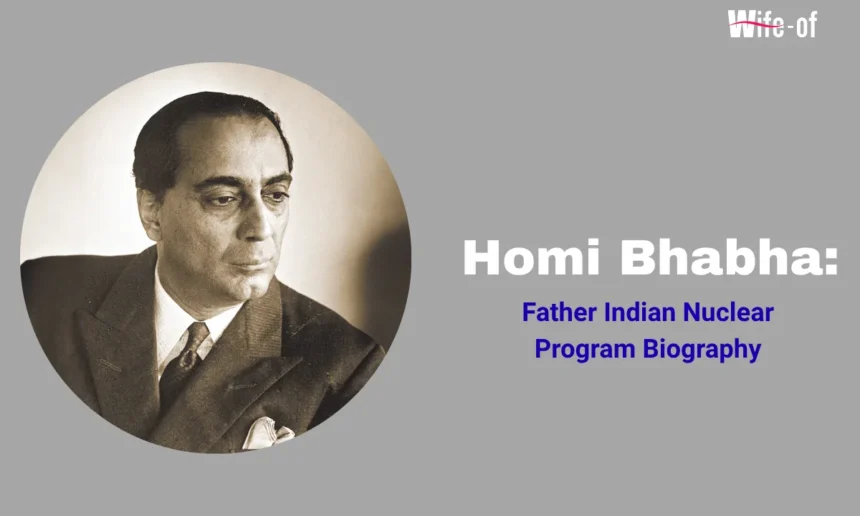
People who search for information about “Homi Bhabha wife” create interest in learning about the personal life of India’s atomic energy architect. Dr. Homi Jehangir Bhabha, the visionary physicist, never entered into marriage, prioritizing his groundbreaking scientific pursuits over personal unions.
Who is Homi Bhabha?
Homi Jehangir Bhabha (1909-1966) was the pioneering Indian nuclear physicist known as the “Father of India’s Nuclear Programme.” He founded key institutions like TIFR and BARC, authoring the thorium-based three-stage nuclear strategy that powers India’s energy independence today.
Bhabha who was born into a rich Parsi family in Mumbai received his PhD degree from Cambridge where he studied under Paul Dirac. He used his research to establish “Bhabha scattering” as a scientific concept in both quantum electrodynamics and cosmic ray shower theory which he developed together with Heitler. He established the Tata Institute of Fundamental Research 1945 with J.R.D. Tata at that time because he returned to his home country after World War II ended. He served as the first head of the Atomic Energy Commission from its founding in 1948 until his death.
Major Contributions
Homi J. Bhabha (right) at the International Conference on the Peaceful Uses of Atomic Energy in Geneva, 20 August 1955.
- Institutions: Founded TIFR (basic research hub) and AEET (now BARC); oversaw Asia’s first research reactor, Apsara (1956).
- Nuclear Vision: Devised three-stage programme—PHWRs (Stage 1: Pu production), FBRs (Stage 2: Pu breeding), thorium AHWRs (Stage 3: U-233 sustainability)—tapping India’s 25% global thorium reserves.
- Global Role: Led 1955 Geneva “Atoms for Peace” conference; positioned India as peaceful nuclear leader while hinting at deterrence capability.
Homi Bhabha Biography Snapshot
| Attribute | Details |
|---|---|
| Name | Homi Bhabha |
| Full Name | Homi Jehangir Bhabha |
| Age at Death | 56 years |
| Date of Birth | October 30, 1909 |
| Birth Place | Bombay (Mumbai), India |
| Birth Sign | Scorpio |
| Home Town | Mumbai |
| Current Residence | Deceased (1966) |
| Nationality | Indian |
| Family Roots | Parsi Zoroastrian |
| Profession | Nuclear Physicist |
| Fame | Father of Indian Nuclear Program |
Homi Bhabha Age Early Life Years
Homi marked his 56th year before the 1966 tragedy, born into 1909 Mumbai privilege where Parsi wealth met intellectual fire. Early years blended family law debates and grandfather’s library dives, igniting a teen prodigy spark by age 15 with Cambridge exam triumphs.
Homi Bhabha Height Weight Physical Stats
| Feature | Description |
|---|---|
| Height | 5 feet 6 inches (approx.) |
| Weight | Not documented (slender build inferred) |
| Hair Color | Black |
| Eye Color | Black |
| Build | Elegant, artistically inclined frame |
Homi Bhabha Childhood Family Influences
Homi Jehangir Bhabha was born on October 30, 1909 to his lawyer father Jehangir Hormusji Bhabha and his mother Meherbai Framji Panday who was the granddaughter of industrialist Sir Dinshaw Petit. The Mysore education chief Hormusji who was Homi’s grandfather named him after himself. Parsi Zoroastrian values emphasized education, grooming him for intellectual pursuits from toddlerhood.
Cathedral School Early Brilliance Age 4-15
Homi entered Mumbai’s prestigious Cathedral and John Connon School around age 4, excelling in mathematics and sciences amid rigorous British-style drills. By 15, he aced the Senior Cambridge Examination with honors, a feat that stunned peers given his youth. Family dinners buzzed with discussions on law and philanthropy, honing his articulate mind.
Elphinstone College Intermediate Years 1924-1926
Too young for overseas study post-Senior Cambridge, Homi enrolled at Elphinstone College (University of Bombay affiliate, now Dr. Homi Bhabha State University namesake). Here, he devoured physics texts, balancing intermediate science coursework with extracurricular debates. At 17, he transferred to the nearby Royal Institute of Science for advanced studies.
Royal Institute Science Bombay Research Spark 1926-1927
Attending a 1927 public lecture by Nobel-bound Arthur Compton on cosmic rays ignited Homi’s lifelong passion—his first exposure to high-energy particles. Under mentors, he dipped into lab work blending teaching and nascent research, solidifying physics over family-favored metallurgy.
Gonville Caius College Cambridge Arrival 1927
In 1927, uncle Dorabji Tata and father shipped Homi to England’s Gonville and Caius College, Cambridge, as a scholar through 1930, targeting mechanical engineering for Tata Steel prospects in Jamshedpur. Initial Tripos coursework tested steam engines and thermodynamics, but Paul Dirac’s quantum lectures pulled him toward theory.
Mechanical Tripos First Class Pivot 1927-1930
Homi powered through Mechanical Engineering Tripos, securing first-class honors in June 1930 despite physics distractions, convincing his father to fund a switch. Letters home pleaded his case: engineering felt rote, physics promised discovery.
Mathematics Physics Tripos PhD Path 1930-1932
Shifting majors, Homi tackled Mathematics Tripos (first-class, 1932) while researching cosmic rays under Dirac’s shadow. Rouse Ball Travelling Studentship (1932-34) funded visits to Pauli, Fermi, and Kramers, enriching his electron-positron work.
Cambridge PhD Cosmic Rays Thesis 1934-1935
Earning PhD in 1934 (some sources 1935), Homi’s dissertation on cosmic ray showers laid Bhabha-Heitler theory foundations, predicting muons. Adams Prize followed, catapulting him as a quantum star before India return.
| Timeline Milestone | Age | Key Event | Outcome |
|---|---|---|---|
| Cathedral School | 4-15 | Honors Cambridge exam | Academic prodigy label |
| Elphinstone/Royal Inst. | 15-17 | Compton lecture | Cosmic rays obsession |
| Cambridge Mech. Tripos | 18-21 | First-class engineering | Family approval pivot |
| Math Tripos + PhD | 21-25 | Dirac mentorship | Bhabha scattering birth |
Homi’s path blended obedience with rebellion, forging the nuclear pioneer’s resolve amid elite pressures.
Homi Bhabha Three Stage Nuclear Program Overview
Bhabha presented this thorium-centric strategy at the 1955 Geneva Atoms for Peace conference, contrasting global uranium reliance with India’s monazite-sourced thorium (25% of world reserves). Natural uranium undergoes processing through Stage 1 heavy water reactors to create plutonium. Stage 2 uses fast reactors to generate additional plutonium. Stage 3 enables advanced breeders to extract uranium-233 from thorium. The system became official in 1958 and now supports India’s 24 GW nuclear power capacity.
Stage 1 Pressurized Heavy Water Reactors PHWR Details
Natural uranium fuels PHWRs like CIRUS (1960) and Rajasthan Atomic Power Station, avoiding enrichment needs since heavy water moderates fission efficiently. U-238 captures neutrons to yield plutonium-239 as byproduct, fueling Stage 2 while generating 1-700 MWe per unit. India operates 22 PHWRs, extracting ~300-400 kg Pu annually per GWe for breeders.
Stage 2 Fast Breeder Reactors FBR Technology
Plutonium-uranium mixed oxide (MOX) drives sodium-cooled FBRs like the 500 MWe Prototype Fast Breeder Reactor (PFBR) at Kalpakkam, core-loaded in 2024 and nearing criticality. Fast neutrons convert U-238 to more Pu-239 (breeding ratio >1), multiplying fissile stock 30-40 times from Stage 1 output while producing power. This bridges to thorium, amassing U-233 feedstock.
Stage 3 Thorium Based Advanced Heavy Water Reactors
U-233 from Stage 2 fuels thorium breeders like the AHWR-300, using light water or heavy water in pin-based or seed-blanket designs for high burnup and passive safety. Thorium-232 transmutes to U-233 via neutron capture, sustaining chain reactions in thermal spectrum reactors for centuries of energy from beach sands. Kakrapar tests validated U-233 fuel; commercial deployment eyes 2050.
| Stage | Fuel Cycle | Key Output | Milestone Reactors |
|---|---|---|---|
| 1 | Natural U in PHWR | Pu-239 | CIRUS, RAPS, MAPS |
| 2 | Pu-U MOX in FBR | Excess Pu-239, U-233 precursor | FBTR (1985), PFBR (2024) |
| 3 | Th-U233 in AHWR | Sustainable U-233 | Test loops, AHWR prototype |
Homi Bhabha Nuclear Vision Challenges Progress
Sanctions post-1974 and 1998 tests delayed imports, but indigenous PHWRs and PFBR fuel cycle closure advanced self-reliance. Reprocessing spent fuel extracts Pu/U, though waste management and U-233 separation tech pose hurdles. By 2032, 13 GWe more capacity targets Stage 2 ramp-up.
India Three Stage Program Global Uniqueness
Unlike uranium-rich nations, India’s thorium focus—envisioned by Bhabha—avoids enrichment dependency, aligning with non-proliferation via closed fuel cycles. Successes like Apsara (1956, Asia’s first research reactor) validate the path toward 30% nuclear mix by 2050.
Homi Bhabha Scientific Discoveries Breakthroughs
Bhabha pioneered “Bhabha scattering,” detailing electron-positron interactions in quantum electrodynamics, a cornerstone still taught worldwide. With Walter Heitler, he explained cosmic ray showers via the Bhabha-Heitler cascade theory, predicting muon existence and relativistic effects in meson decay. These 1930s feats at the Indian Institute of Science under C.V. Raman elevated India’s research profile amid World War II disruptions.
Homi Bhabha Tata Institute Founding Vision
In 1945, Bhabha convinced J.R.D. Tata to fund the Tata Institute of Fundamental Research (TIFR) in Mumbai, creating Asia’s premier basic science hub overlooking the Arabian Sea. He envisioned self-reliant research free from colonial constraints, recruiting global talent while nurturing Indian minds. TIFR’s cosmic ray lab and math wing became incubators for talents like Harish-Chandra.
Homi Bhabha Atomic Energy Commission Leadership
Appointed India’s first Atomic Energy Commission chairman in 1948, Bhabha aligned nuclear tech with Nehru’s modernization drive, securing Canada and U.S. reactor aid. He masterminded the Atomic Energy Establishment Trombay (AEET, now BARC), commissioning Asia’s first research reactor Apsara in 1956. His three-stage program—PHWRs, fast breeders, thorium reactors—targeted India’s vast thorium for energy security.
| Stage | Reactor Type | Fuel Focus | Milestone |
|---|---|---|---|
| 1 | Pressurized Heavy Water | Natural Uranium | CIRUS (1960) |
| 2 | Fast Breeder | Plutonium-Uranium | Prototype in 2024 |
| 3 | Advanced Heavy Water | Thorium-Uranium-233 | AHWR design |
Homi Bhabha Cosmic Rays Nuclear Advocacy
Bhabha’s cosmic ray obsession led to high-altitude observatories in Ooty and Kashmir, decoding particle showers and mesons with precision. He championed peaceful nuclear uses at the 1955 Geneva UN conference, positioning India as a moral atomic leader while quietly advancing military potential. Post-China’s 1964 test, he assured capability within months, sparking global intrigue.
Homi Bhabha Awards Honors Global Recognition
Elected Royal Society Fellow in 1941, Bhabha snagged the Adams Prize and led the International Union of Pure and Applied Physics (1960-63). India’s Padma Bhushan (1954) and global accolades underscored his dual role as scientist-statesman. Statues and fellowships perpetuate his name across BARC and TIFR campuses.
Homi Bhabha Death Plane Crash Conspiracy Theories
En route to a Vienna IAEA meeting, Bhabha died on January 24, 1966, when Air India Flight 101 slammed into Mont Blanc in fog-shrouded Alps, killing 117. Theories allege CIA sabotage via radioactive sabotage or navigation tampering, citing declassified notes and his bomb timeline boast to CBS. Official reports blame pilot error; the debate fuels documentaries and books.
Homi Bhabha Legacy Institutions Impact Today
Bhabha’s blueprint powers India’s 24 GW nuclear capacity, with thorium tech nearing reality at PFBR Kalpakkam. TIFR and BARC alumni drive ISRO, DRDO successes, from Chandrayaan to Agni missiles. His artist-scientist persona—sketching Nehru, playing violin—humanizes the nuclear icon.
Homi J. Bhabha (1909–1966)
Known as the “Father of the Indian Nuclear Programme,” his “books” are primarily collected scientific papers and foundational policy reports that shaped India’s scientific landscape.
| Book / Publication Title | Year | Description |
| Collected Scientific Papers | 1985 (Posthumous) | A compilation of his 60+ research papers on cosmic rays and quantum theory. |
| On Cosmic Radiation… | 1935 | His doctoral thesis from Cambridge, foundational to modern particle physics. |
| The Cascade Theory of Cosmic Ray Showers | 1937 | Co-authored with Walter Heitler; explained how cosmic rays interact with the atmosphere. |
| The Three-Stage Nuclear Power Programme | 1954 | The strategic roadmap for India’s energy independence using thorium. |
| Science and the Problems of Development | 1966 | A notable speech/essay reflecting on the role of science in a developing nation. |
Homi K. Bhabha (born 1949)
A leading figure in contemporary postcolonial studies, his books are staple texts in humanities and literary theory.
| Book Title | Year | Key Concepts / Subject |
| Nation and Narration | 1990 | Explores how nations are “constructed” through stories and literature. |
| The Location of Culture | 1994 | His most famous work; introduces terms like Hybridity, Mimicry, and Third Space. |
| Edward Said: Continuing the Conversation | 2005 | A collection of essays discussing the legacy of the author of Orientalism. |
| Our Neighbours, Ourselves | 2011 | Reflections on global ethics and survival in a contemporary world. |
| The Urgency of Theory | 2008 | Discusses the necessity of critical thinking in times of global crisis. |
Homi Bhabha Love Life Companion Bonds
Pipsy (Phiroza Wadia) shadowed conferences and papers, defying norms as closest confidante without vows. Rumors swirled of Paris artist flames, but heart stayed science-bound.
Homi Bhabha Wife & Marriage Details Never Wed
Zero records of matrimony; Homi quipped “married to creativity,” dodging Parsi match pressures for nation-first focus.
Homi Bhabha Family Parents Siblings Ties
Father Jehangir (barrister), mother Meherbai (Petit kin); brother Jamshed helmed NCPA post-death. Uncle Dorabji Tata bankrolled Cambridge.
His Relationship with Jawaharlal Nehru
Homi Bhabha shared a close, collaborative partnership with Jawaharlal Nehru, blending scientific vision with political support to launch India’s nuclear program. As India’s first Prime Minister, Nehru backed Bhabha’s ambitious plans, providing crucial funding and autonomy despite post-independence resource strains.
Key Collaborations
Homi J. Bhabha (right) at the International Conference on the Peaceful Uses of Atomic Energy in Geneva, 20 August 1955.
- TIFR Funding: Nehru endorsed Bhabha’s 1945 Tata Institute pitch, securing government grants that turned a sea-facing Mumbai mansion into Asia’s top physics hub.
- Three-Stage Program: Bhabha convinced Nehru at 1955 Geneva Atoms for Peace talks to prioritize thorium over uranium imports, aligning with India’s self-reliance mantra.
- Apsara Reactor: Nehru’s greenlight sped Asia’s first research reactor (1956) at Trombay, showcasing peaceful atoms while building dual-use know-how.
Homi Bhabha Net Worth Breakdown Estate Value
No personal fortune tracked; estate via brother Jamshed topped Rs 300-372 crore by 2014 bungalow sale, funneled to NCPA culture push.
Conclusion
Bhabha dedicated his life to studying quantum theory and cosmic rays while he worked on developing his nation. Pipsy’s relationship with Bhabha brought essential human qualities that balanced his exceptional intellectual abilities. The scientist established his intellectual gathering space at his Mumbai bungalow which overlooked the ocean and hosted events that combined scientific and artistic and musical disciplines. The scientist lived as a single man because he believed that personal sacrifice would help society progress.
FAQs
Who was Homi Bhabha and his role in India?
Father of India’s nuclear program, TIFR founder, AEC chairman who built self-reliant atomic infrastructure.
What did Homi Bhabha invent in physics?
Bhabha scattering theory, cosmic ray shower model, muon predictions.
How did Homi Bhabha start nuclear India?
Via TIFR (1945), AEET (1954), three-stage thorium plan.
Homi Bhabha death cause real story?
Mont Blanc plane crash 1966; conspiracies persist but accident ruled official.
Homi Bhabha family and personal details?
Unmarried Parsi from Mumbai elite; brother Jamshed handled estate.
Also read: Nirmal Kaur (Wife of Milkha Singh): Bio, Age, Family, Career, Volleyball Captain and More