

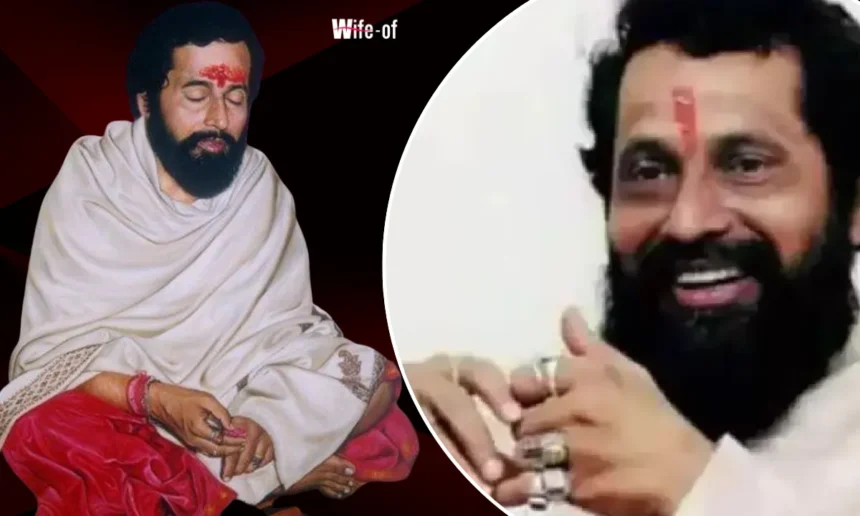
Anand Dighe’s personal life and marriage is one of the most searched topics on the internet. Anand Dighe, popularly known as Dharmaveer, was a mass leader and dominated the political arena of Thane district in Maharashtra for decades. His political career, daily darbars at Tembhi Naka and mentorship to key leaders such as Eknath Shinde are widely known. However, there is great demand from thousands of individuals to learn more about Anand Dighe’s wife and his married status. To clear up the air of confusion by putting forth historically correct facts, here’s a brief glimpse of his personal life, family and biography.
Who is Anand Dighe?
Anand Chintamani Dighe was an Indian politician, social activist and was the Thane unit chief of Shiv Sena political party. Hailing from Chandraseniya Kayastha Prabhu (CKP) community of Maharashtra, Dighe emerged from humble origins. It was his ceaseless public service, absolute dedication and mass connect that propelled him to fame as a leader. Revered as a ‘people’s leader’ who was active round-the-clock, he earned the title ‘Dharmaveer’ (Protector of Religion/Righteousness). Dighe passed away on August 26, 2001, due to cardiac arrest following a road accident.
Anand Dighe Biography & Personal Profile
| Attribute | Details |
| Full Name | Anand Chintamani Dighe |
| Popular Title / Other Name | Dharmaveer, Anand Dighe Saheb |
| Date of Birth (DOB) | January 27, 1951 |
| Place of Birth | Murud-Janjira (or Apta), Bombay State, India |
| Date of Death | August 26, 2001 (Aged 50 years) |
| Home Town & Residence | Thane, Maharashtra, India |
| Nationality | Indian |
| Profession | Politician, Social Worker, and Mass Leader |
| Religion | Hinduism |
| Political Party | Shiv Sena |
| Claim to Fame | The undisputed “Kingmaker” of Thane politics and mentor to top Maharashtra leaders |
Anand Dighe Physical Statistics
- Height: Approximately 5 feet 8 inches
- Eye Color: Dark Brown
- Hair Color: Grey/White (Distinctive beard and long hair style)
- Appearance: He was known for his iconic look featuring a flowing beard, traditional attire, and a saffron tilak on his forehead.
Anand Dighe School and College Career
Primary and secondary education of Anand Dighe were carried out in Maharashtra. He made inroads in the sphere of social services and student activism at a very tender age. An overwhelming call to do good to society drifted him away from the general corporate career and student’s studies to welfare of the common man and local politics.
Anand Dighe Career-Ascension-to-Fame:
The ascent of Anand Dighe into a celebrated public figure rests on his overwhelming love for the local residents of Thane. He became the Shiv Sena Thane Unit President in 1984. He started “Janata Durbar” a daily public meeting at his residence Tembhi Naka where each person could approach him and the solutions were provided then and there on the spot because of his massive local sway in society.
Career Timeline & Politics
- Early 1970s: Joined Shiv Sena as a young grassroots party worker, inspired by Balasaheb Thackeray.
- 1984: Officially took charge as the Shiv Sena Thane District Chief, solidifying the party’s grip over the region.
- 1989: Accused in a controversial political case and arrested under the Terrorist and Disruptive Activities (Prevention) Act (TADA), which sparked massive public protests by his followers. He was later released on bail.
- 1980s – 2001: Mentored a generation of grassroots workers, directly shaping the careers of leaders like Eknath Shinde, Rajan Vichare, and Naresh Mhaske.
- August 2001: Met with a major vehicular accident near Vandana Talkies while returning from a local Ganesh Utsav event, leading to his untimely demise.
Business and Entrepreneurship
It’s an interesting point that Anand Dighe never operated his politics and social work as a business. He owned no commercial firms or any private ventures. He was a whole time social worker and political organizer whose profession he solely used to manage local developments.
Anand Dighe Awards and Recognition
While Anand Dighe did not chase formal civil honors, his true recognition lay in the absolute reverence of his followers.
- He was honored with the title “Dharmaveer” by the public.
- The modern Dharmaveer Anand Dighe Natyamandir auditorium in Ambernath is named after him.
- His life story inspired the highly successful Marathi biographical movies Dharmaveer (2022) and Dharmaveer 2 (2024), where actor Prasad Oak brought his legacy alive on screen.
Anand Dighe Wife & Marriage Status
The Facts: Anand Dighe was never married. He remained a lifelong bachelor.
For the sake of social service, public duty he dedicated his whole life. In his life he did not get married/entered into the family life because he has to be at the disposal of the citizens at the full time without any break. His past friends and biographies also support the idea that at some part in his early life there was some marriage proposal but Dighe totally dedicated himself to public welfare and he looked upon the citizens of Thane as his family. Thus all the online news stating the name of the “Anand Dighe wife” is a false report.
Anand Dighe Family Details
Anand Dighe belonged to a close-knit, middle-class family that stayed strictly away from political limelight.
- Father: Chintamani Dighe (Passed away when Anand was quite young)
- Mother: Nirmaladevi Dighe
- Brother: Padmakar Dighe
- Sister: Aruna Dighe Gadkari
- Nephew: Kedar Dighe (Who performed his last rites at the age of 19)
Early Life, Family Background, and Roots
Anand Dighe was born and spent his childhood in the humble surroundings of Tembhi Naka, a locality within the town of Thane in the Indian state of Maharashtra. Long before it grew to be the seat of power within the region, Tembhi Naka was primarily a blue-collar residential area and it was in these humble circumstances that the young Dighe witnessed firsthand the abject poverty and the socio-economic plight of the local masses.
The Dighe family hailed from the Chandraseniya Kayastha Prabhu (CKP) community. His father, Chintamani Dighe, died at an early stage of his life, leaving his family struggling to come to terms with economic and emotional problems. These early experiences influenced Dighe and led him to lead a life of social work instead of following a family oriented course of married life and the rigours of corporate life.
Architectural Leadership: The Style of Functioning
Anand Dighe did not operate within standard bureaucratic frameworks. He pioneered a hands-on, highly decentralized style of leadership that completely bypassed administrative delays.
1. Anand Ashram – The Parallel Court
This entire mass grievance redressal system was legitimized by Dighe by establishing the Anand Ashram at Tembhi Naka. It was an open house from 6 am daily and it served as a real court of the common man. Whether it were family feuds or land grabbing or just problems with utility services, Dighe would listen to the complaints and summon high municipal or police officials directly from his office, guaranteeing immediate on the spot solutions.
2. Unemployment:
Dighe was different from our macro economic policy driven politicians as his economic development was on a much smaller and immediate scale. After starting the Thane Municipal bus services and its subsequent extension into the region he negotiated job opportunities for hundreds of local unemployed youth in the state transport bodies as well as local factories and in turn set up small business stalls in and around the Thane-Kalyan belt and helped young unemployed boys become entrepreneurs.
Cultural Revitalization & Social Movements
One of the most visible but largely unexamined elements of Dighe’s legacy was his strategic utilization of regional culture for the collective empowerment of the local community and affirmation of identity.
- The Tembhi Naka Mitra Mandal Dahi Handi: Dighe’s first act was to transform a mundane local game of Dahi Handi from a small, amateur affair to a massive, highly organized and expensive community sporting-cultural event, transforming street-level sport into a spectacle drawing international acclaim, and bestowing substantial funding on local youth organizations.
- The Navratri Festival: He created a series of colossal, public Navratri performances under the aegis of his own social trust, Jai Ambe Sanstha. This was explicitly structured to foster social unity by providing free cultural entertainment to families and subtly tapping the community for donations towards local welfare funds.
- The Malanggad Campaign: Strongly connected to the Nath traditions, Anand Dighe orchestrated a monumental public campaign from the 1980s and 1990s to stake a historical claim for the region over the well-known hilltop shrine, identifying it as Malanggad belonging to Machhindranath. It was this extensive, localized social and political campaign that resulted in state recognition for the site as Malanggad in 1996.
Early National Stance: The Ram Mandir Movement
Though historical narratives have given his influence in the Thane region, Anand Dighe has been at the forefront of pan Indian movements. Long before the Ram Mandir movement took center-stage as a pan Indian programme of political parties, Anand Dighe has been its fierce and unapologetic follower.
After events unfolded in Ayodhya in the early 1990s, Anand Dighe was one of the first public figures from Maharashtra to have sent a symbolic silver brick/stone to Ayodhya for the temple’s foundation stone in a low key, unobtrusive and non commercial, non-PR exercise thus establishing him as an unapologetic, true soldier of Hindutva amongst the ideologues.
The TADA Arrest and Political Backlash
On March 1989 the Thane Municipal Corporations elections saw political battle in the extreme. Shiv Sena secured 30 seats, formed an alliance with Janata Party and bagged mayoral post. Unexpectedly due to internal cross voting, Shiv Sena’s candidate Prakash Paranjpe lost mayorship with a margin of 1 vote.
The internal political treachery and double dealing resulted in the murder of Shridhar Khopkar, a Shiv Sena corporator. Anand Dighe was arrested for allegedly planning the revenge and was taken under TADA (Terrorist and Disruptive Activities) Act.
- The complete, sudden shutdown of Thane city with thousand s of common citizens poured in street took place after his arrest.
- The legal trial took years to end and Anand Dighe remained on bail until his death without ceasing his daily public durbars.
The Tragic Demise and Conspiracy Theories
The death of Anand Dighe on August 26, 2001, remains shrouded in massive regional grief, medical controversy, and political debate.
During the ongoing Ganeshotsav festival in August 2001, Dighe was traveling past midnight after visiting local public pandals. Near Vandana Talkies in Thane, his jeep collided heavily with a municipal bus exiting a depot. Dighe suffered a fractured tibia (shinbone) and secondary head trauma. He was rushed immediately to the Sunitidevi Singhania Hospital in Thane.
| Chronology of August 25-26, 2001 | Events and Medical Outcomes |
| Midnight, Aug 25 | Vehicular accident near Vandana Talkies; admitted to Singhania Hospital. |
| Morning, Aug 26 | Orthopedic surgical team performs bone setting operation on his leg. |
| Afternoon, Aug 26 | Sudden internal medical collapse; hospital announces death due to cardiac arrest. |
| Evening, Aug 26 | Enraged followers, alleging medical negligence, vandalize and destroy the hospital. |
When and How did Anand Dighe Pass Away?
Anand Dighe passed away on August 26, 2001, at the age of 50. He met with a severe vehicular accident near Vandana Talkies in Thane after midnight during the Ganeshotsav festival. He was admitted to Singhania Hospital, where he underwent surgery for a fractured leg, but tragically suffered a fatal cardiac arrest later that afternoon.
Net Worth & Income Source
- Net Worth: Minimal personal assets.
- Income Source: Community donations, party provisions, and basic ancestral assets.
Dighe lived a very unassuming, monklike life, though according to various political commentators he was one of the most influential ‘kingmakers’ in the State of Maharashtra. He made no accumulation of private wealth and real estate, diverting whatever funds he commanded towards community activities, public holidays and relief programs.
Hidden Facts About Anand Dighe
- The Lucky Number 13: Much like Shiv Sena supremo Balasaheb Thackeray, Anand Dighe considered the number 13 highly auspicious, often aligning important events around it.
- The TADA Arrest: His arrest under the stringent TADA laws didn’t diminish his popularity; instead, it turned him into an iconic regional hero, triggering mass shutdowns across Thane out of public solidarity.
- Deep Grief: Close associates note that despite his tough outer exterior, Dighe wept privately when a local newspaper published an emotional report after his mother’s death, mentioning how she passed away dreaming of seeing her son get married.
Conclusion
Anand Dighe’s life was a living example of commitment to grass roots politics. Constant queries related to Anand Dighe’s wife shows how people still remain enthusiastic about his private life. The reality is he himself embraced celibacy and a bachelorship so that his attention would be directed only towards helping the masses. The city of Thane was his family and his memory still guides the state’s politics today.
FAQs
Who was Anand Dighe’s wife?
Anand Dighe never married and remained a lifelong bachelor.
Who are the family members of Anand Dighe?
Anand Dighe belonged to a close-knit, middle-class family. His father was Chintamani Dighe and his mother was Nirmaladevi Dighe.
Why was Anand Dighe called “Dharmaveer”?
The title “Dharmaveer” (meaning Protector of Righteousness or Religion) was bestowed upon Anand Dighe by the public due to his fearless defense of local cultural traditions.
Also read: Jenna Ali (Wife of Kieron Pollard): Age, Bio, Business, Height, Career & Net Worth